Blog
Why the Engineering Industry Should Take a Serious Look at Space-Based Data Centers
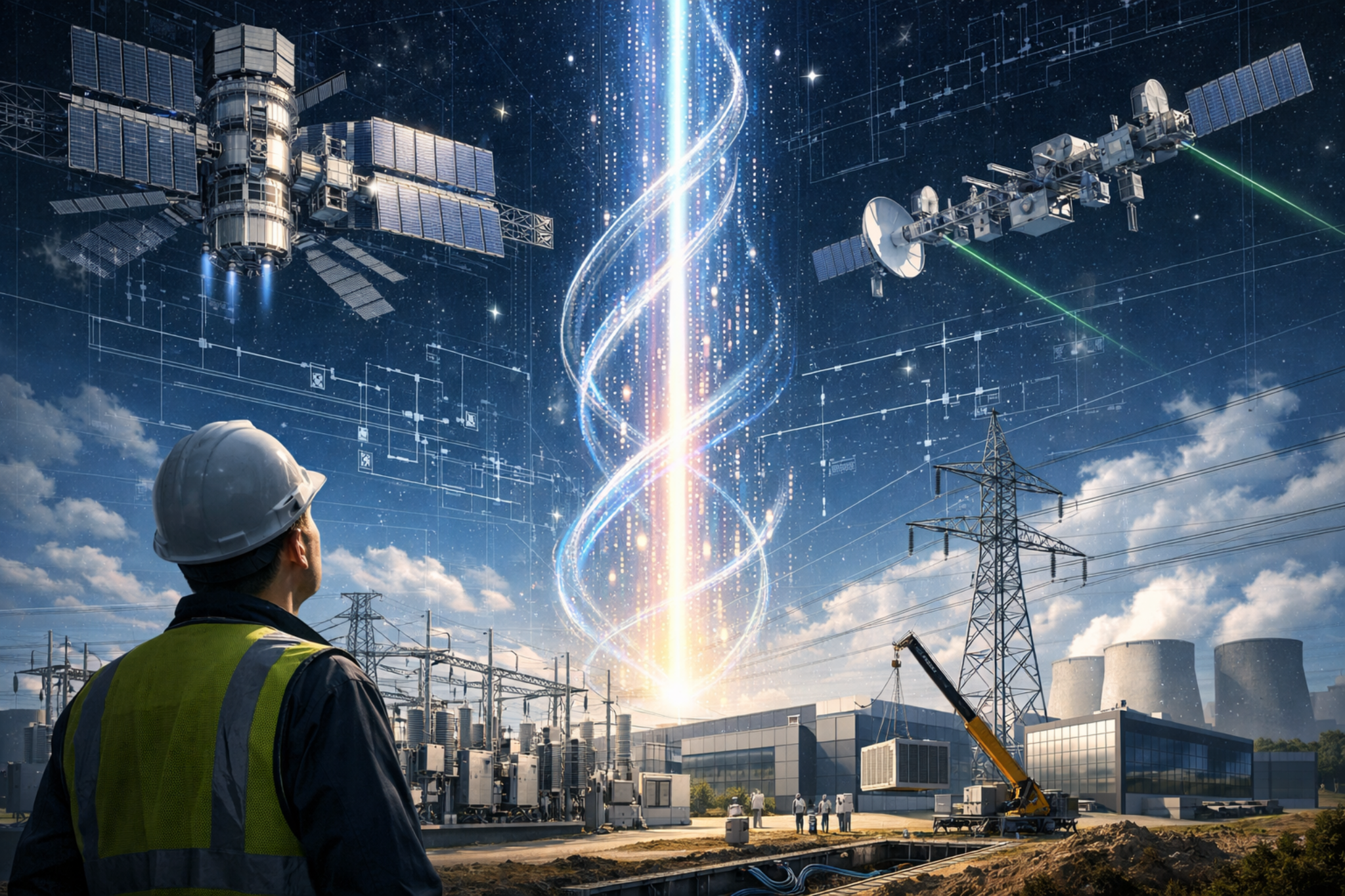
I have spent the past decade working as EPC contractor and have seen projects of every size and type. Yet few topics have preoccupied me as much as space-based data centers. They look like distant science fiction, but they may reshape the engineering industry faster and more profoundly than most people expect.
The reason is straightforward. A space-based data center is not simply a server farm moved into orbit. It is better understood as relocating part of “compute” as a foundational capability away from the constraints of terrestrial power grids and land, and into a spatial layer whose boundaries are defined by orbital resources, communications links, and international rules.
If we accept a basic fact of the AI era, namely that the expansion of compute is becoming inseparable from the supply of energy, then “orbital compute” will not remain a niche aerospace narrative for long. It will increasingly enter the agenda of national capability and industrial competition, and in doing so will push outward the boundaries of what the engineering sector must be able to deliver.
Terrestrial Data Centers Are Already Becoming Power Projects
The expansion of ground-based data centers is increasingly a power-engineering problem, not a pure IT problem.
As compute demand rises, it first collides with grid interconnection, energy quotas, cooling and water constraints, transmission and distribution upgrades, permitting, and construction timelines. For engineers, these constraints are familiar: to scale, you must answer where the electricity comes from, how the grid connects, how the station is built, and how energy consumption is approved.
Space-based data centers point to a different route. They shift energy supply from the ground grid to solar irradiance, place continuity of power on orbital selection and attitude control, and place heat rejection on radiative heat transfer and thermal-control design.
They do not eliminate the constraints of power and heat. They relocate them from Earth to orbit. That structural shift reorders the bottlenecks: terrestrial constraints move to the background, while new bottlenecks emerge in launch, on-orbit deployment, thermal control, reliability, servicing, and decommissioning.
Orbit Is Not a Backdrop, It Is the Constraint Itself
Not every orbit suits a data center. The choices that look most feasible from an engineering standpoint often lean toward dawn-dusk Sun-synchronous orbits.
The reasons are practical. Near-continuous sunlight reduces dependence on onboard energy storage. The thermal environment is comparatively stable, making it easier to keep radiators oriented favorably over long periods. The overall system is more amenable to repeatable, standardized modules, which is an important precondition for mass production and deployment.
The key is not the name of the orbit, but the engineering logic behind it: once the primary contradictions of power supply and thermal management move into the orbital environment, many terrestrial bottlenecks are replaced by a different set. In the end, the most sensitive variables are still two curves, the cost curve and the reliability curve.
Whether It Scales Depends on Whether Two Curves Interlock
Whether space-based data centers can move from concept to scale does not depend on how grand the vision is. It depends on whether two curves can interlock.
The first is the pace at which unit costs fall, specifically whether the unit cost of launch and on-orbit deployment can drop rapidly with scale. In essence, this asks whether Wright’s Law can be transferred to aerospace manufacturing and high-cadence launch systems.
The second is the stability of system availability as scale increases, meaning whether the system can maintain high uptime as it grows. That includes on-orbit lifetime, electronic reliability under radiation, management of micro-debris risk, on-orbit servicing capability, and end-of-life disposal mechanisms.
The first curve determines whether it can become a business. The second determines whether it can become infrastructure. If the two cannot hold at the same time, the story is unlikely to become an industry.
Orbital Competition Encounters Rules and Borders Earlier
Shift the lens from technology to geopolitics and the picture sharpens. Space-based data centers move part of industrial competition from the ground into orbit, and orbital competition naturally involves coordination and bargaining among states.
The expansion of terrestrial power generation is mostly constrained by domestic policy and domestic engineering capacity. Orbital systems, by contrast, touch international rules and cross-border links earlier and more frequently. That introduces several practical constraints.
The first comes from orbital capacity and space traffic management. Low Earth orbit is not infinite. As the number of objects in orbit grows, collision avoidance, disposal, debris mitigation, and information sharing become increasingly important. For leaders, this is a cost and systems-engineering problem. For latecomers, it becomes a barrier to entry and a source of uncertainty. The barrier may not appear as an explicit blockade; it may emerge from the cumulative weight of technical standards, licensing procedures, and liability regimes.
The second comes from spectrum and registration rules. International Telecommunication Union radio regulations play a critical role in frequency coordination and satellite-network filings. In the era of large non-GEO constellations, the core constraints often show up in frequency coordination and milestone-based deployment requirements. For companies, filing is not enough; deployment capability is what makes the filing meaningful. For states, aerospace capability, industrial organization, and launch capacity translate more directly into usable regulatory position.
The third comes from supply chains and finance. Orbital compute is not a single product. It depends on high-reliability electronics, advanced materials, thermal-control systems, communications payloads, launch and on-orbit services, and long-term support from insurance, reinsurance, financing, and contract-performance environments. Volatility at any link can shift cost curves and delivery schedules. In this context, geopolitics rarely appears as slogans. It appears as export controls, underwriting preferences, financing costs, and cross-border compliance requirements, all of which can systematically raise the catch-up cost for latecomers.
The fourth comes from earlier regulatory involvement. Even when pursued under a commercial banner, communications, remote sensing, navigation enhancement, and data processing carry clear dual-use attributes. Policy and regulation therefore enter earlier in the project lifecycle, giving competition both industrial-policy and security-policy characteristics. This does not guarantee confrontation, but it does make it difficult for long-term strategic competition to disappear.
Neither Science Fiction Nor a Binary Confrontation Narrative
If we write from technological imagination alone, the topic becomes science fiction. If we write from geopolitical imagination alone, it becomes a confrontation story.
I prefer a simpler test: when a piece of infrastructure has both the potential to scale and meaningful strategic externalities, latecomers will struggle to treat it as an ordinary commercial project.
Policy support is not the same as national mobilization, and it does not require replicating historical models. More often it shows up as clearer rules, more stable procurement and test mechanisms, more explicit spectrum and orbital strategies, more predictable development of launch and on-orbit servicing capacity, and long-term investment with tolerance for trial and error at critical links.
The EPC Opportunity Is Not in Orbit, but in System-Level Engineering Capability
This is why space-based data centers deserve attention from the engineering industry. They shift compute expansion from a single terrestrial problem of power and civil works into a system problem shaped jointly by power engineering, aerospace engineering, communications engineering, and institutional design. Once a system problem forms, it reshapes investment direction, standards, project organization, and supply-chain structure.
I do not intend to steer the discussion into a comparison between private capital and state capital. For late-developing countries, policy support is a real variable. For companies, what matters more is identifying the engineering segments they can enter and the pathways by which capabilities can transfer.
From an EPC contractor’s perspective, the most immediate connection to space-based data centers is not in orbit. It is on the ground, and it lies in the ability to deliver complex systems.
The first opportunity lies in supporting ground infrastructure. No matter how orbital compute evolves, ground stations, mission operations centers, link access nodes, and associated facilities are indispensable. These assets demand higher standards of power reliability, power quality, redundancy, and electromagnetic compatibility than typical industrial projects, and they are often located in remote areas or under challenging boundary conditions. For EPC contractors, the methodology is consistent with conventional energy and power projects: system design, procurement systems, construction organization, commissioning and handover, and long-term operations and maintenance capability become decisive.
The second opportunity lies in engineering capability around power electronics and high-reliability power systems. On-orbit power management and regulation are aerospace products, but the underlying engineering logic still centers on power electronics, energy storage management, and reliability design. Companies with experience in power-system integration need not manufacture core flight hardware. A more realistic entry point is providing services around test systems, ground validation platforms, simulation and reliability assessment, and supply-chain quality systems. The engineering industry excels at turning complex systems into deliverable systems, and that strength is often underestimated during periods of cross-domain convergence.
The third opportunity lies in end-to-end solutions across space and ground. Space-based data centers are unlikely to fully replace terrestrial data centers. More plausibly, a hybrid structure will persist for a long time. Hybrid architectures create new engineering questions: how to allocate compute workloads across scenarios, how to plan terrestrial power and network resources, how to achieve system-level optimality under energy constraints, and how to coordinate across domains under compliance and security requirements. Teams that understand both power systems and data-center engineering can gain a new kind of pricing power, because they deliver not merely construction but system-level feasibility and execution.
Conclusion: The Definition of Engineering Is Expanding
I am not writing this to manufacture anxiety. I am arguing for a practical view: space-based data centers represent an engineering pathway that could reshape the relationship between compute and energy. Their progress is shaped by technology curves as well as by rules and competitive structure.
For latecomers, policy support aims to reduce systemic uncertainty and shorten the catch-up cycle. For enterprises, the key is to break the system into actionable engineering segments and locate where their capabilities can realistically transfer.
As an entrepreneur, a business leader, and an engineer, I focus on two questions. First, will this competition move the engineering industry into a new era in which engineers do not merely build equipment, but deliver systems that integrate rules, links, energy supply, and reliability? Second, while long-term competition persists, is there still room to build shared rules for sustainable operations? If the orbital environment falls into disorder, the cost will not respect nationality, and the risk will not favor any side.