TFC Communication is often described with a short market slogan: optical components, NVIDIA, 1.6T, and co-packaged optics. That description is directionally useful and analytically dangerous. TFC is not a GPU supplier. It is not primarily a complete optical-transceiver brand. It does not manufacture every active chip it packages. Its value sits in a narrower and more interesting place: high-precision optical components, optical-engine integration, fiber-to-chip connectivity, and scalable packaging across several architectures.
The strongest TFC thesis is not that it will replace every optical-module company. It is that it can capture a larger share of the value inside each optical link while remaining useful to several module architectures and several downstream customers.
The build-out map
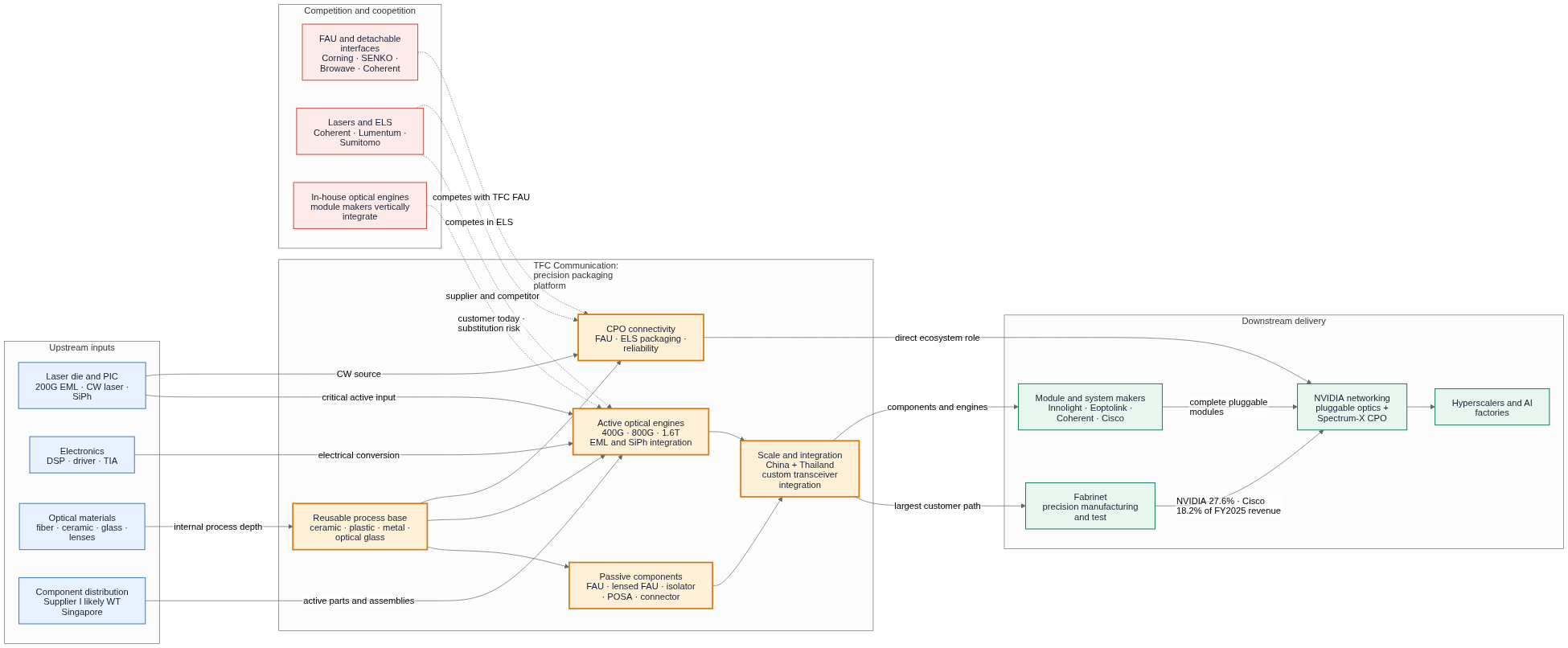
The map exposes the central relationship. TFC buys scarce active inputs, combines them with its own passive-component and packaging capabilities, then sells components and engines through optical manufacturers and module makers into NVIDIA, Cisco, and the wider AI-factory market. Some of the same companies can be supplier, customer, partner, and competitor at different layers.
What TFC actually sells
| Layer | TFC products and capabilities | Where value is created | Main substitution risk |
|---|---|---|---|
| Material and process base | Precision ceramics, engineering plastics, metal composites, optical glass, micro-optics, coating and assembly know-how | Repeatable alignment, low loss, consistency, yield, reliability, and manufacturability | Customers or larger vertically integrated photonics companies reproduce the process stack |
| Passive components | FAU and lensed FAU, isolators, ferrules and sleeves, adapters and connectors, lens arrays, Z-blocks, POSA and WDM assemblies | Fiber coupling, optical routing, packaging density and stable high-volume assembly | Corning, SENKO, Browave, Coherent and specialist domestic suppliers |
| Active components | 400G, 800G and 1.6T optical engines; EML, CW-DFB and silicon-photonics integration; customized engine packaging | Turns laser die, drivers, optics and coupling structures into a functional electro-optical subassembly | Module makers internalize optical engines; laser and silicon-photonics suppliers move downstream |
| CPO | FAU, precision fiber connectivity, external-laser-source packaging and reliability work | Connects fiber and external light to co-packaged silicon-photonics engines at production yield | Detachable interfaces standardize, customers dual-source, or CPO adoption is slower than expected |
| Integration and capacity | Customized transceiver integration plus manufacturing in China and Thailand | Qualification, global delivery, process transfer and customer supply-chain resilience | Thailand ramp cost, material shortage, customer concentration and price pressure |
TFC’s Hong Kong listing application says active optical components were 58.1% of its 2025 listing-basis revenue, up from 38.5% in 2023. Passive components were 40.4%. Active gross margin was 46.1%, versus 63.3% for passive components. The strategic trade is therefore clear: optical engines expand TFC’s addressable market and content per link, but they also import expensive chips and lower the blended gross margin.
The same application, using a Frost & Sullivan report commissioned for the listing, ranks TFC first globally in externally sold optical components in 2025 with 11.7% share, and says TFC held the highest FAU revenue share. This is meaningful evidence of scale, but it is not an audited independent market-share registry and it is not a dFAU share. The top-five component suppliers together held only 25.4%, which also shows how fragmented the market remains.
EML, CW and silicon photonics are not interchangeable labels
A laser die is the bare semiconductor chip that generates or modulates light before it is packaged. TFC’s optical-engine value is primarily in integrating such chips with drivers, optics, fiber coupling and a reliable mechanical package. Public filings do not show that TFC owns the full supply of 200G EML laser die.
| Route | How light carries data | Typical fit | Implication for TFC |
|---|---|---|---|
| EML | A continuous-wave laser and electro-absorption modulator are integrated in an InP device; the light is modulated at the laser package | High-speed pluggable links including 1.6T modules using eight 200G lanes | TFC packages externally sourced 200G EML material into optical engines; supply and yield of the die are critical |
| CW laser + SiPh | An external continuous-wave laser supplies unmodulated light; a silicon-photonics modulator encodes the data | Pluggable silicon-photonics modules and CPO | TFC can supply FAU, coupling, engine integration and external-laser packaging without owning the silicon-photonics PIC |
| ELS | An external laser source is a serviceable module containing one or more CW lasers, control and thermal functions | CPO switches where the optical engine sits next to the switch ASIC | TFC’s role is packaging and reliability integration; Coherent, Lumentum and Sumitomo remain powerful laser and ELS competitors |
TFC said its first-quarter 2026 optical engines were mainly single-channel 200G products and mainly EML. Its Thailand active line remained at small volume in the first half because 200G EML material was tight. This is both proof of real demand and proof that TFC does not control its most scarce active input.
Who ultimately uses TFC’s EML engines?
No public product-level disclosure names the end user of a specific TFC 200G EML engine. The furthest defensible named chain is:
TFC’s listing application says Customer A bought passive components, active components and other products worth RMB 3.269 billion in 2025, equal to 63.9% of listing-basis revenue. Its description, a Cayman-incorporated NYSE-listed company focused on optical packaging and precision optical manufacturing and testing, matches Fabrinet with high confidence. Fabrinet’s own FY2025 10-K says NVIDIA and Cisco accounted for 27.6% and 18.2% of its revenue.
That identifies the downstream manufacturers. It does not identify which TFC part entered which Fabrinet program. Multiplying TFC’s 63.9% Customer A exposure by Fabrinet’s 27.6% NVIDIA exposure would create false precision. TFC sells several product families to Fabrinet, and Fabrinet manufactures several product families for NVIDIA.
dFAU: first-tier position, no defensible public share
TFC’s public documents usually say FAU. NVIDIA describes a detachable optical connector in the Spectrum-X CPO package. No primary source reviewed for this article explicitly names a TFC part number as “dFAU.” TFC did say in July 2026 that its CPO FAU design was finalized and in order delivery, and that FAU and ELS capacity preparation could support continued customer ramp.
| Supplier | Named downstream acceptance | Evidence assessment | Public share |
|---|---|---|---|
| TFC | NVIDIA CPO ecosystem; company says CPO FAU is finalized and in order delivery | Strong ecosystem and commercial evidence, but customer, part number and dFAU naming remain anonymous | Not disclosed |
| Corning | Qualified optical-infrastructure supplier for Broadcom TH5-Bailly; multiyear NVIDIA optical-connectivity partnership | Very strong named system and production evidence | Not disclosed |
| SENKO | Lightmatter vClick uses MPC and SEAT detachable FAU technology; work disclosed with GlobalFoundries | Very strong detachable-interface product and foundry evidence | Not disclosed |
| Coherent | NVIDIA CPO ecosystem; demonstrates FAU, silicon-photonics CPO and ELS across a vertically integrated stack | Powerful cross-layer competitor; NVIDIA dFAU share not disclosed | Not disclosed |
| Browave | NVIDIA fiber and connector ecosystem | Ecosystem acceptance is public; exact dFAU product and volume are not | Not disclosed |
The correct conclusion is not “TFC is number one in dFAU.” It is: TFC is a first-tier CPO fiber-connectivity supplier with an FAU product in order delivery, while Corning and SENKO currently provide clearer public evidence for specifically detachable interfaces.
TFC versus Innolight, Eoptolink and Fabrinet
These companies are not four interchangeable optical-module makers.
| Company | Primary role | 2025 revenue / net profit | Relationship with TFC | Relationship with NVIDIA |
|---|---|---|---|---|
| TFC Communication | Optical components, engines, FAU and advanced packaging | RMB 5.163bn / RMB 2.017bn | Central subject; upstream of complete modules | Named CPO ecosystem partner; indirect pluggable path through manufacturers |
| Innolight | Complete high-speed optical transceivers | RMB 38.240bn / RMB 10.797bn | Potential customer and coopetitor; can buy components while internalizing engines | Named by NVIDIA as a pluggable-transceiver industry leader |
| Eoptolink | Complete high-speed optical transceivers | RMB 24.842bn / RMB 9.532bn | Potential customer and coopetitor; markets both EML and SiPh 1.6T modules | Named by NVIDIA as a pluggable-transceiver industry leader |
| Fabrinet | Contract manufacturing, precision packaging, final assembly and testing | US$3.419bn revenue / US$333m net income for FY2025 | High-confidence match for TFC’s largest customer | NVIDIA was 27.6% of FY2025 revenue |
TFC’s 2025 revenue was only about 13.5% of Innolight’s and 20.8% of Eoptolink’s. Its net profit was about 18.7% and 21.2% of theirs. TFC therefore cannot displace their complete-module shipment position merely by adding optical-engine capacity. Complete modules require customer-level design wins, DSP and electrical design, firmware, thermal engineering, compliance, field support and procurement relationships. Entering that market aggressively could also turn TFC’s customers into opponents.
The more credible disruption is inside the profit pool. If TFC sells more of the engine, FAU, POSA, ELS packaging and integration content per optical link, it can grow faster than a passive-component supplier without becoming a complete-module brand. It can become more important to Innolight and Eoptolink while competing with the parts they prefer to keep in-house.
The strongest advantages
- A cross-architecture process platform. TFC can participate in EML, silicon-photonics pluggables and CPO through different combinations of optics, FAU, packaging and integration.
- Passive-to-active vertical expansion. The company is no longer dependent on low-value standalone passive pieces; active components became the largest listing-basis segment in 2025.
- High-precision volume manufacturing. Material know-how, alignment, coating, coupling and packaging can be reused across product generations, which is more durable than one module form factor.
- Real customer qualification. Customer A rose to 63.9% of listing-basis revenue after a relationship beginning in 2018. Fabrinet describes optical manufacturing qualification as a three-to-six-month or longer process.
- Named NVIDIA relevance. NVIDIA lists TFC in its silicon-photonics ecosystem, while describing Eoptolink, Fabrinet and Innolight as pluggable-optics leaders. This confirms TFC’s different layer rather than making it another module company.
- Global manufacturing option. Thailand provides a path for customer qualification and geopolitical resilience once the active line moves beyond small-volume production.
The disadvantages that matter
- Customer concentration is extreme. Customer A was 63.9% and the top five were 90.6% of listing-basis revenue in 2025.
- Supplier concentration is also high. Supplier I represented RMB 833m, or 34.8% of 2025 purchases. The most likely match is a Singapore sales entity in Taiwan-listed WT Microelectronics, with WT Microelectronics Singapore as the leading candidate, but the legal entity is not confirmed.
- The scarce active chip is external. The 200G EML shortage constrained first-half 2026 production. Packaging skill cannot create laser die supply.
- Mix expansion can dilute margin. Active optical components carry lower gross margin than passive components because raw-material content is higher.
- CPO is both opportunity and cannibalization. It creates FAU and ELS packaging demand but removes switch-side pluggable transceivers and uses fewer lasers in NVIDIA’s architecture.
- Competition is multi-directional. Corning and SENKO attack connectivity; Coherent competes from material to module; laser vendors move into ELS; module customers internalize engines.
- The valuation already assumes success. A great industrial position can still be a poor security if the price discounts several years of execution.
Market value: reverse the assumptions, do not worship the target
On the last trading day before this article, July 10, 2026, Tushare reported a close of RMB 271.12, total market value of approximately RMB 295.7bn, TTM PE of 136.2× and PB of 49.5×. These figures imply roughly RMB 2.17bn of trailing earnings, close to but above the RMB 2.017bn reported for 2025.
The table below is not a price target. It is a reverse-valuation test for 2030. Each market-value outcome uses a lower terminal PE as the company matures, then asks how much net profit must exist and how fast trailing earnings must compound for four years.
| Market value scenario | Illustrative 2030 PE | Required 2030 net profit | Multiple of current implied TTM profit | Four-year profit CAGR required | What must become true |
|---|---|---|---|---|---|
| RMB 400bn “4000亿” | 60× | RMB 6.67bn | 3.1× | 32.4% | 1.6T engine supply normalizes; active growth remains strong; CPO contributes without collapsing margin |
| RMB 600bn “6000亿” | 55× | RMB 10.91bn | 5.0× | 49.7% | TFC becomes a global cross-architecture engine, FAU and ELS platform with much larger capacity and multiple scaled customers |
| RMB 1tn “1万亿” | 50× | RMB 20.0bn | 9.2× | 74.2% | TFC captures a much larger system-level profit pool, avoids commoditization, and sustains extraordinary growth despite a larger base |
RMB 400bn is not absurd, but it is not cheap upside from the current base. It requires more than tripling normalized profit by 2030 while retaining a premium multiple. RMB 600bn requires TFC to reach roughly the 2025 net-profit scale already achieved by today’s largest Chinese module makers, but from a much smaller revenue base. RMB 1tn requires a category change, not a normal product cycle. It should be treated as an extreme upside option until product revenue, customer diversification and capacity evidence say otherwise.
At the current 136× TTM multiple, almost any target can be made to look arithmetically easy. The difficult assumption is keeping 136× while the company becomes larger. A useful valuation therefore normalizes the multiple and forces the operating thesis to do the work.
What would upgrade or break the thesis
- Product-level disclosure of 200G EML-engine customers or a named NVIDIA/Fabrinet program
- Thailand active line moving from small volume to qualified scale
- 200G EML material availability improving without a severe price penalty
- CPO FAU and ELS revenue, units, ASP or customer count disclosed
- Customer A concentration declining because other customers scale faster
- Active gross margin stable or rising despite mix growth
- Major customer internalizes engines or replaces TFC
- Corning, SENKO or Coherent wins the detachable-interface standard while TFC remains anonymous
- CPO displaces pluggable content faster than TFC gains FAU and ELS content
- Laser-die shortages persist and customers redesign around other architectures
- Revenue grows but cash conversion, gross margin or customer terms deteriorate
- Valuation remains extreme while earnings growth slows
Why this matters for AI4EPC
The reusable system is more valuable than this single stock conclusion. An EPC project contains the same analytical problem at a different scale: anonymous subcontractors, OEM bottlenecks, long qualification cycles, components that change role by package, suppliers that are also competitors, country-of-origin constraints, capacity claims, and contract exposure that cannot be understood from a vendor list.
An AI4EPC implementation can ingest approved vendor lists, bids, technical submittals, inspection records, factory capacity, shipping data, owner standards and public evidence. It can build a versioned graph of who supplies what, which package depends on which upstream input, where single-source risk lives, what evidence proves acceptance, and which commercial claim is still inference. It can then regenerate a project page whenever a filing, shipment, test, delay or supplier disclosure changes.
This article is one working example. The agent moved from a set of questions to an evidence ledger, an editable build-out map, a reverse valuation and a publishable web page without inventing missing customer names or market shares. That is the product lesson. TFC is the case study.
Evidence cutoff: July 11, 2026. Market data reflect July 10, 2026. This is industrial research, not investment advice. Anonymous customer and supplier identities are explicitly marked as inference.
Primary and official sources
- TFC Communication Hong Kong listing application draft
- TFC Communication financial reports
- TFC investor-relations record, June 27, 2026
- TFC investor-relations record, July 9, 2026
- TFC ECOC 2025 1.6T EML and silicon-photonics solutions
- NVIDIA CPO announcement and partner ecosystem
- NVIDIA CPO technical architecture
- Fabrinet FY2025 Form 10-K
- Corning and Broadcom TH5-Bailly CPO collaboration
- NVIDIA and Corning multiyear optical-connectivity partnership
- SENKO and Lightmatter detachable FAU announcement
- Coherent CPO, FAU and ELS demonstrations at OFC 2026
- Eoptolink 1.6T EML and SiPh transceivers
- Innolight AI and data-center transceiver portfolio
- Eoptolink 2025 operating results
- Innolight 2025 annual-report summary
- WT Microelectronics acquisition of Future Electronics
- Tushare daily price API documentation and daily valuation API documentation