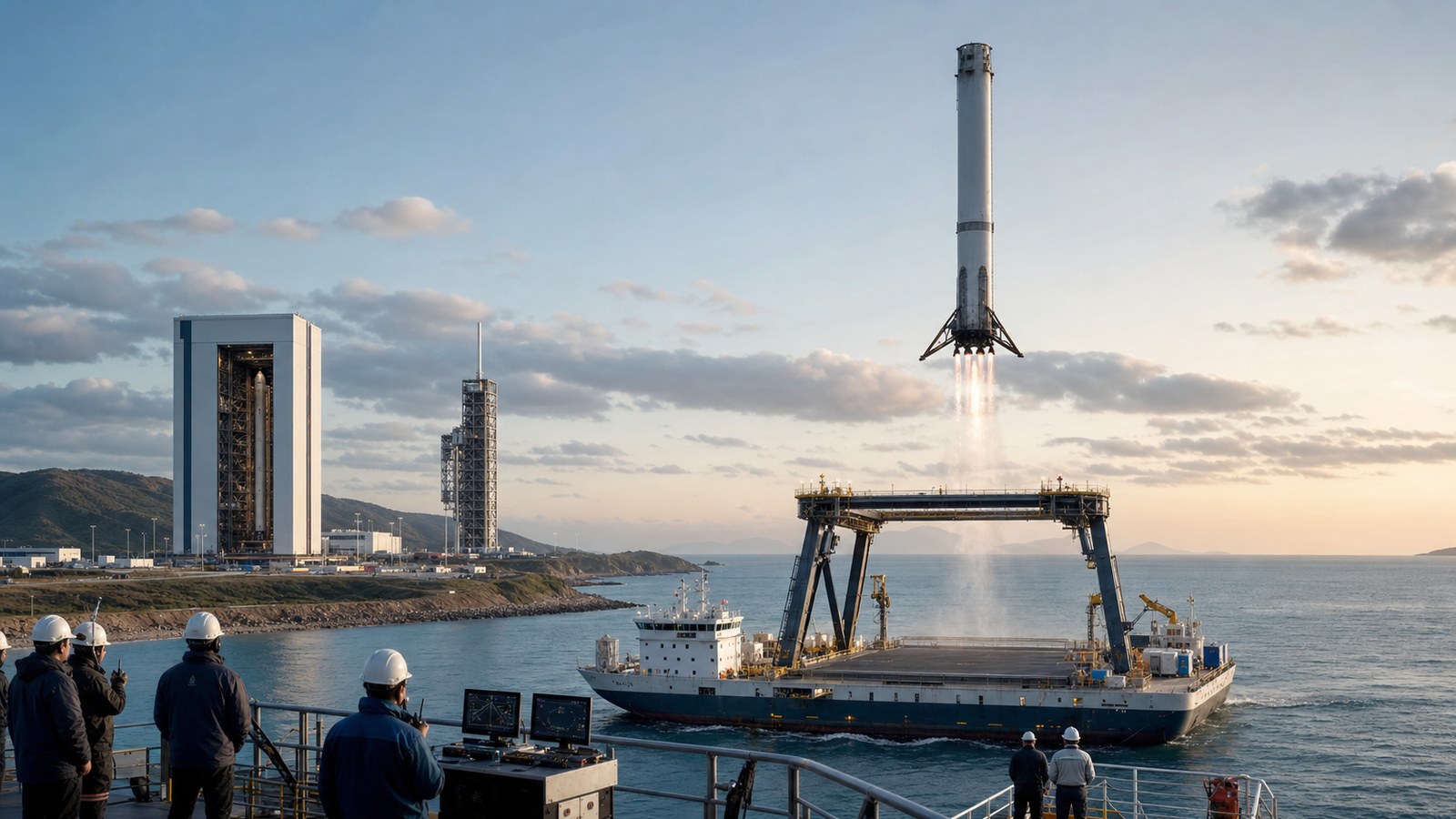
On July 10, social reports circulated that a Chinese reusable booster had completed a sea-based net capture. The engineering significance would be considerable, but the evidence boundary matters. As of July 11, I have not found a mission-owner announcement that confirms the claimed capture. The official baseline remains the February 11 Long March 10-series test: the first stage completed its return flight, performed a controlled splashdown, and was later salvaged. The China Aerospace Science and Technology Corporation described formal sea-net capture as a later step.
That distinction is not caution for its own sake. Reusability is one of the easiest industrial subjects to misunderstand. A dramatic landing proves control authority for a few minutes. A reusable launch business must prove reliable ascent, return, recovery, inspection, refurbishment, launch-site flow, payload demand, insurance acceptance, and profitable repetition. The second flight of the same stage matters more than the first recovery. The twentieth matters more than the second.
China has a credible path to lead the next space-industrial era. It also has a strategic need to pursue that position. Neither claim requires pretending that China has already matched SpaceX's operating record. The more useful argument is that China possesses several ingredients that no other SpaceX challenger has assembled at the same scale: a complete manufacturing base, multiple state and commercial rocket architectures, national satellite demand, coastal launch infrastructure, maritime engineering, patient capital, and a policy framework that now treats launch, recovery, manufacturing, standards, applications, and insurance as one system.
The opportunity is real. So is the distance still to travel.
The benchmark is operational repetition
SpaceX is the benchmark because Falcon 9 converted recovery from a demonstration into routine production. In its June 2026 European prospectus, SpaceX reported approximately 620 Falcon 9 orbital launches through March 31, 2026, an overall mission success rate above 99 percent, more than 570 successful booster landings, and more than 540 missions flown by flight-proven rockets. Of 165 Falcon 9 launches in 2025, 157 used flight-proven boosters.
Those numbers describe a learning machine. Every recovered stage returns engines, valves, tanks, avionics, thermal exposure, vibration history, and inspection findings to the engineering organization. The launch rate creates the data. The data improves maintenance rules. Better maintenance supports the next increase in launch rate.
China starts from a different base. The Long March family has accumulated more than 630 launches with a reported success rate above 97 percent, which demonstrates deep competence in expendable launch reliability. Reusable orbital operations are newer. China's 2024 twelve-kilometer vertical takeoff and landing test validated deep-throttling liquid-methane engines, landing legs, guidance, health monitoring, and controlled descent at meaningful scale. In December 2025, LandSpace's Zhuque-3 placed its second stage into orbit while its first-stage recovery attempt failed after abnormal combustion during the return. LandSpace then completed the second Zhuque-3 vehicle's static-fire test on June 29, 2026.
That sequence should be read professionally. Orbital insertion plus a failed recovery is not reusable service. It is also not an empty result. It provides full-flight data that a short vertical-hop test cannot produce. The important signal is whether the organization closes the failure investigation, changes the design or operating envelope, flies again, recovers a stage, and then reflys the recovered hardware.
China should not build only one answer
Falcon 9 returns its first stage using restartable engines, grid fins, four landing legs, and either a land pad or an autonomous drone ship. This architecture carries landing hardware and reserve propellant on the vehicle, but its operating behavior is proven.
The Long March sea-net concept moves part of the landing interface off the rocket. The booster returns under powered guidance with an onboard suspension interface. A dynamically positioned maritime platform provides the capture structure and part of the energy absorption. In theory, removing large landing legs and transferring some structural work to the platform can improve the booster's mass allocation.
The trade is demanding. The guidance system no longer targets a fixed concrete pad. It must manage a moving ship, waves in six degrees of freedom, wind, salt spray, communication latency, a narrow capture geometry, concentrated structural loads, post-capture safing, and recovery operations far from the factory. Weather availability becomes part of launch capacity. Corrosion and maritime maintenance become part of rocket economics.
China is therefore developing at least two important paths. One is the Falcon-like vertical landing route, pursued by Zhuque-3 and several other commercial programs using liquid methane or kerosene engines, grid fins, landing legs, and deep throttle. The other is the state-led maritime recovery route, where shipbuilding, dynamic positioning, heavy structures, cable systems, navigation, and ocean operations become part of the launch vehicle.
Running parallel architectures is an advantage during exploration. It becomes wasteful if every company recreates the same test facilities, interfaces, ground systems, and supplier qualification rules. The industrial goal should not be to declare every design a winner. It should be to test quickly, publish measurable outcomes, standardize what can be shared, and concentrate recurring launch demand on the systems that demonstrate reliable reuse.
Why Chinese leadership is feasible
1. Demand can be sovereign, commercial, and continuous
A reusable rocket cannot mature on occasional prestige missions. It needs payloads. China has national satellite-internet programs, remote-sensing constellations, navigation augmentation, direct-to-device communications, scientific missions, lunar exploration, and a growing commercial satellite sector. The National Space Administration's 2025-2027 commercial-space action plan explicitly connects low-cost, reliable, responsive, reusable launch vehicles with low-Earth-orbit communications, navigation, remote sensing, commercial launch sites, sea launch, recovery zones, integrated tracking, and international applications.
This matters because launch demand and launch cost reinforce each other. Lower cost alone does not create a market. A large constellation program creates a launch manifest, manufacturing repetition, standardized payload interfaces, and pressure to reduce cost. Reuse then makes the next layer of demand more economical.
2. China's manufacturing depth is unusually broad
Reusable launch vehicles connect industries that China already operates at scale: high-performance metals, stainless and aluminum structures, composites, precision machining, additive manufacturing, welding, power electronics, sensors, industrial software, machine tools, shipbuilding, telecommunications, batteries, and automated production. This does not make any ordinary industrial supplier space-qualified. It does reduce the distance between a design requirement and a domestic manufacturing solution.
The strongest advantage may be the ability to industrialize after the physics works. Wuxi's Zhuque-3 manufacturing base includes assembly, tank testing, tank-section welding, sheet-metal manufacturing, digital manufacturing, and additive manufacturing. Hainan's commercial launch site supports multiple rocket types and propellants. A national common test platform under construction is designed to provide vibration, acoustic, thermal-vacuum, electromagnetic-compatibility, and full-scale environmental testing for large rockets and satellites.
These are not background facilities. They determine whether a rocket remains a hand-built prototype or becomes a product.
3. State programs and private companies can learn in parallel
China's state system brings long-duration mission demand, human-spaceflight requirements, test infrastructure, and deep systems engineering. Commercial companies bring narrower product focus, faster configuration changes, private capital discipline, and willingness to use industrial materials and manufacturing methods differently.
Long March, Zhuque, Hyperbola, Tianlong, Nebula, Pallas, and other programs should not be treated as interchangeable names in a concept basket. They represent different propellants, stage sizes, engine cycles, recovery methods, manufacturing strategies, and business models. The valuable national asset is not the number of PowerPoint rockets. It is the number of teams that reach flight, publish failures honestly, correct them, and win recurring customers.
4. Standards are arriving before high-cadence reuse
In April 2026, the National Space Administration and the State Administration for Market Regulation published Commercial Space Standards System 1.0. It spans governance, research and manufacturing, launch and tracking, applications, common foundations, and facilities. The plan specifically calls for standards covering first-stage recovery, testing, recovery handling, cleaning and reuse, rapid launch processes, interfaces, components, materials, and shared facilities.
This is a less visible reason China can scale. High-rate aerospace production requires common vocabulary, acceptance criteria, configuration control, traceability, and a way for state-owned and private suppliers to enter each other's chains. Standards should not freeze immature technology. They should remove repeated non-competitive work while preserving safety and measurable quality.
Why leadership is necessary
Space access is becoming industrial infrastructure. Communications, navigation, Earth observation, disaster response, weather, maritime services, precision agriculture, logistics, financial timing, national security, and future in-orbit computing all depend on it. If launch remains scarce and expensive, satellite factories produce inventory rather than operating networks.
China also cannot base strategic space infrastructure on another country's launch cadence, export rules, ground terminals, constellation priorities, or insurance market. Independent launch capacity is not isolation. It is the minimum condition for negotiating international cooperation from a position of capability.
There is an economic reason as well. A high-cadence reusable launch sector creates demanding domestic customers for engines, sensors, materials, electronics, software, robotics, ships, test equipment, and precision manufacturing. It can force improvement in reliability engineering and digital production far beyond rockets.
The environmental and safety case is equally important. Frequent launches require controlled drop zones, propellant handling, debris mitigation, maritime coordination, third-party liability, and transparent accident investigation. China's policy now calls for full-life-cycle safety checks and a compulsory insurance framework for commercial space activities. Leadership without these systems would produce launch volume without a durable industry.
The Chinese technology stack to watch
Propulsion and propellant systems
The engine is not a single component. Reuse depends on turbopumps, injectors, combustion chambers, nozzles, bearings, seals, valves, ignition systems, actuators, sensors, and control software surviving repeated thermal and mechanical cycles. The practical metrics are restart count, deep-throttle range, mixture-ratio control, coking or residue, hot-fire life, inspection time, replaced parts, and performance drift across flights.
Liquid methane offers clean combustion and a path toward lower refurbishment, while liquid kerosene benefits from mature infrastructure and high density. China should continue both where the mission economics justify them. The winning engine will not be the one with the best isolated specification. It will be the one that starts repeatedly, throttles predictably, comes back with inspectable life, and can be produced at rate.
Structures, tanks, and manufacturing
Watch large-diameter stainless structures, aluminum alloys, composite fairings, friction-stir and laser welding, tank domes, common bulkheads, thermal protection, grid fins, landing structures, and additive-manufactured engine parts. Reuse changes the optimization target from minimum mass on one flight to minimum lifecycle cost across many flights.
Non-destructive inspection will become a major industry in its own right. Ultrasonic, radiographic, optical, acoustic, and structural-health data must be linked to the serial number and flight history of every critical part. A recovered rocket without a trustworthy digital history is an expensive object, not a reusable fleet asset.
Guidance, navigation, control, and health monitoring
Return flight requires inertial navigation, satellite navigation, radar or other relative navigation, flight computers, fault-tolerant software, power systems, high-bandwidth actuators, grid-fin control, engine gimbaling, and real-time health estimation. Maritime capture adds ship-motion prediction, high-integrity communications, dynamic positioning, and cooperative guidance between vehicle and platform.
China's electronics and telecommunications base is a strong starting point, but aerospace qualification, radiation tolerance, deterministic software, supply-chain traceability, and fault containment remain the barrier. Consumer-electronics scale is useful only after it is converted into aerospace reliability.
Reentry aerothermodynamics and thermal protection
Repeated reentry imposes heat, vibration, acoustic loads, plume interaction, and fatigue that do not appear in a one-way rocket. Thermal protection must be inspectable and repairable. Computational fluid dynamics, wind-tunnel testing, high-temperature coatings, insulation, structural instrumentation, and post-flight data reconstruction deserve as much attention as the landing video.
Maritime recovery and turnaround
The sea-net route creates a new industrial chain: dynamically positioned vessels, capture structures, high-strength cables and interfaces, wave forecasting, marine radar, deck robotics, fire suppression, hazardous-material safing, corrosion protection, towing, port handling, and transport back to the factory.
Company disclosure must be read carefully. Highlander's 2025 annual report describes a command-and-control vessel project and orders related to Hainan reusable-rocket sea recovery. That is an operationally relevant disclosure, but it does not identify the July claim or a specific Long March vehicle. Sirui Materials discloses liquid-rocket thrust-chamber materials and components. Chaojie Fastener discloses commercial-rocket structures, fairings, valves, and tank plans. These are useful industrial signals, not proof that any company supplied a specific mission.
Launch sites, test assets, and logistics
Hainan's commercial launch site has two operating pads and was designed for multiple rocket types and propellants. In early 2026, reported pad occupancy for one mission fell from ten days to five. Future capacity depends on parallel processing, standardized connections, rapid checkout, propellant storage, weather resilience, range safety, transport, and recovery-zone coordination.
Engine stands, vibration tables, acoustic chambers, thermal-vacuum facilities, electromagnetic testing, and large clean rooms are capacity constraints. Opening national test facilities to commercial companies, as the action plan proposes, can save capital and increase learning. Access rules must be predictable enough for a launch company to plan a production schedule.
Satellites, terminals, and applications
Reusable launch has no standalone business case without payload demand. The downstream chain includes satellite platforms, phased-array antennas, radio-frequency front ends, laser inter-satellite links, onboard computing, power systems, flexible solar arrays, user terminals, ground gateways, tracking networks, and application software.
This is where China can turn manufacturing strength into a flywheel. Standardized satellites create launch demand. High launch cadence reduces deployment cost and shortens replenishment cycles. Larger constellations improve service. Service revenue supports the next generation of spacecraft and launch vehicles.
Insurance, regulation, finance, and failure data
A reusable fleet needs rules for vehicle certification, flight-history transfer, component life, third-party liability, environmental risk, recovery zones, and customer acceptance of flight-proven hardware. Insurers and customers need more than a successful landing. They need failure rates, inspection criteria, configuration records, and evidence that refurbishment decisions are controlled.
Patient capital is necessary because engines, launch sites, and test facilities require years of expenditure before stable revenue. It should be paired with milestone discipline. Funding should follow verified tests, completed flights, recovered hardware, reuse, customer contracts, and manufacturing throughput. Capital that rewards announcements without flight data creates more programs and less capability.
How to measure a world-leading Chinese system
I would track a short set of operating measures rather than declarations:
- Orbital mission success and first-stage recovery success, reported separately.
- The number of recovered stages that actually fly again.
- Flights per individual stage and engine.
- Calendar time and labor hours from recovery to flight readiness.
- Parts inspected, repaired, and replaced after each flight.
- Payload delivered after recovery reserves and weather constraints.
- Factory throughput, pad occupancy, launch cadence, and recovery availability.
- Customer mix, repeat orders, insurance terms, and on-time mission performance.
- Cost per delivered kilogram based on actual fleet operations, not advertised price.
- Independent safety, environmental, and failure-investigation quality.
China does not need to beat SpaceX on every metric at once. It can lead in selected architectures, maritime recovery, manufacturing cost, responsive constellation deployment, or integrated space infrastructure. Global leadership becomes credible when those advantages survive repeated flights and paying customers.
The condition for leadership
China's greatest advantage is not a single rocket. It is the possibility of connecting rockets, engines, factories, test centers, launch sites, recovery ships, satellite production, ground networks, applications, standards, insurers, and capital into one industrial learning system.
Its greatest risk is the opposite: too many isolated programs, duplicated facilities, suppliers selected by narrative, concealed failures, and launch demand allocated without commercial feedback.
The July net-capture story is therefore useful even while it remains unconfirmed. It directs attention toward a genuinely original engineering route. It also reminds us that one spectacular event cannot establish technical or economic leadership.
China can lead this industry if it measures what comes after recovery: inspection, refurbishment, reuse, cadence, cost, safety, and customer value. It needs to lead because the next generation of communications, sensing, navigation, computing, lunar infrastructure, and space-based industry will be built by countries that can reach orbit as a repeatable production process.
Space infrastructure is EPC under the most unforgiving conditions. The country that learns to engineer, manufacture, launch, recover, verify, and improve it as one system will set more than the price of a rocket ride. It will shape the industrial rules of the next space economy.
Primary and official sources
- China Aerospace Science and Technology Corporation: Long March 10-series first sea-recovery test
- China Aerospace Science and Technology Corporation: first-stage sea salvage after the February 2026 test
- Xinhua: onboard suspension interface and sea-net recovery architecture
- China National Space Administration: Zhuque-3 orbital flight and recovery-test result
- LandSpace: Zhuque-3 second vehicle static-fire test, June 29, 2026
- LandSpace: Zhuque-3 and TQ-12A product specifications
- Shanghai Municipal Commission of Economy and Informatization: twelve-kilometer reusable-rocket vertical-flight test
- China National Space Administration: national launch and in-orbit space-system statistics
- China National Space Administration: Commercial Space High-Quality and Safe Development Action Plan, 2025-2027
- China National Space Administration and State Administration for Market Regulation: Commercial Space Standards System 1.0
- State-owned Assets Supervision and Administration Commission: Hainan Commercial Space Launch Site dual-pad capability
- Jiangsu Maritime Safety Administration republication: Hainan pad-occupancy reduction and 2026 recovery work
- Wuxi Huishan government: Zhuque-3 intelligent manufacturing base
- Shanghai municipal policy: commercial-space advanced-manufacturing supply chain
- National Science and Technology Innovation Center: common commercial-space test platform
- SpaceX: mission and reusability overview
- SpaceX: June 2026 European prospectus, operational data through March 31, 2026
- Highlander 2025 annual report
- Sirui Materials 2025 annual report
- Chaojie Fastener investor-relations record