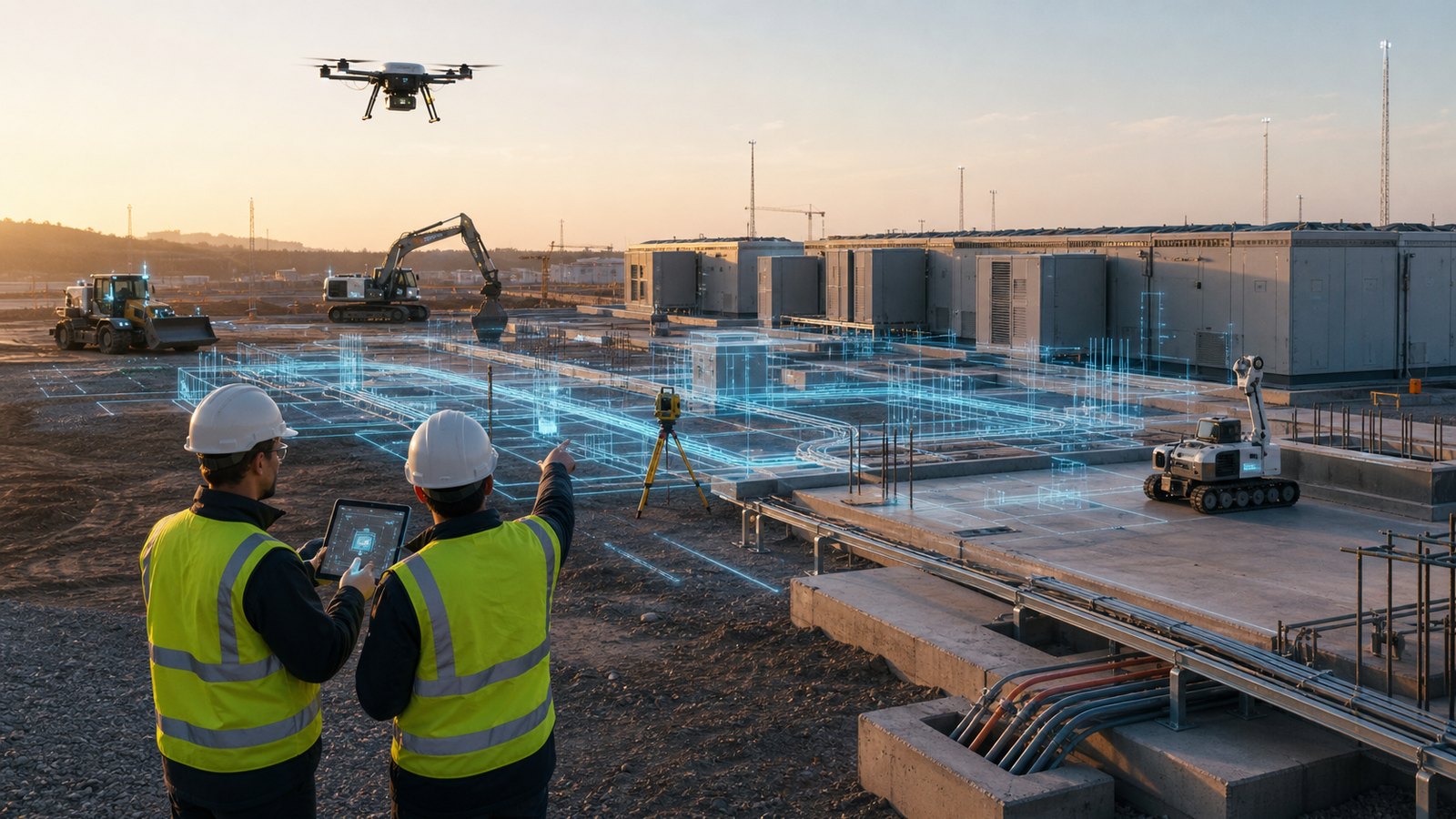
The future EPC company will be disrupted by AI.
Before the industrial revolution, production depended on skilled craftsmen. A blacksmith was not only a worker. He carried process knowledge in his hands, eyes, habits, tools, and local judgment. Then factories, machine tools, standardized parts, gauges, jigs, and process control changed the structure of production. The world did not solve manufacturing by training infinite blacksmiths. It changed the production system.
EPC will go through the same kind of structural change.
Today's EPC company is still built around human coordination. Drawings, schedules, method statements, procurement plans, subcontractor packages, site meetings, inspection records, and commissioning documents are tied together by managers, engineers, foremen, and trades. This system can still deliver large projects, but it does not scale well when the world needs more data centers, power assets, grid upgrades, industrial facilities, and eventually infrastructure beyond Earth.
The future EPC company will not be a bigger version of today's contractor. It will be an AI-for-EPC company.
This distinction matters. The core idea is not generic automation. Automation is the operating result. AI for EPC is the operating logic. It means turning engineering intent into machine-readable work packages, field execution plans, physical AI actions, evidence, and reusable learning.
Robots are part of this story, but they are not the whole story. A robot is one body of physical AI. Autonomous heavy equipment, robotic layout machines, drones, scanners, mobile manipulators, robotic arms, sensor networks, edge AI devices, digital twins, and commissioning agents are all physical AI endpoints. The important loop is perception, planning, action, verification, and learning in the physical world.
That is the layer AI4EPC is being built to provide.
The first flagship market should be data centers.
A data center is not just a building. It is a power project, a cooling project, a network project, a controls project, a civil project, a commissioning project, and a reliability asset compressed into one schedule. If the power system is late, the data center is late. If cooling is wrong, compute cannot run. If cabling, controls, commissioning, or as-built evidence is weak, the asset is not ready for serious workloads.
So the right question is:
Can a data center be built by AI and robots?
The answer is yes, if we change the way the data center is designed, procured, built, verified, and learned from.
The weak version of the question imagines a conventional construction site and asks whether robots can simply replace every trade tomorrow. That is the wrong mental model. The stronger version is to design the data center as a robot-readable, modular, machine-verifiable infrastructure product from the beginning.
This means AI4EPC should not sell "robots for construction" as a narrow product. It should sell the AI-for-EPC operating layer that makes robots, modules, suppliers, contractors, inspectors, and owners work as one execution system.
For a data center, the power side can be decomposed into machine-readable packages: site grading, trenching, foundations, behind-the-meter energy infrastructure, transformer pads, prefabricated electrical rooms, switchgear skids, UPS modules, battery blocks, generator interfaces, cable trays, busway, grounding, protection tests, and energization evidence.
The data side can be decomposed the same way: modular data halls, rack rows, containment, fiber routes, structured cabling zones, sensor locations, controls points, cooling distribution, network tests, and digital as-built records.
The site execution layer can also be decomposed: coordinates, tolerances, material staging, crane paths, robot paths, safe work zones, inspection checkpoints, rework rules, exception approvals, and commissioning handoffs.
Once the project is decomposed like this, the question becomes practical:
Which parts should be executed by physical AI on site?
Which parts should be manufactured as modules off site?
Which parts still need supervised human work because the regulatory, safety, integration, or exception risk is too high?
Which work package is valuable enough to become the first paid pilot?
This is where AI4EPC can build a real business.
The first product is not a grand promise that an entire data center can be built by a single universal robot. The first product is an AI-for-EPC assessment for one real scope. A customer sends a data center or energy infrastructure package. AI4EPC decomposes it, scores it, and identifies the best automation wedge.
The score should be engineering-based:
- Repeatability
- Geometry clarity
- Labor scarcity
- Safety risk
- Robot readiness
- Module readiness
- Material presentation
- Supplier readiness
- Inspection evidence
- Commissioning impact
- Regulatory risk
- Reuse potential on the next site
From that score, AI4EPC can produce a robot-ready and module-ready method statement. This is more useful than a slide deck. It should define coordinates, tolerances, sequence, safety zones, required machine interface, material packaging, operator role, inspection points, sensor records, exception logic, and owner acceptance evidence.
Then comes the paid pilot.
The pilot could be a repetitive civil package, a power infrastructure package, a cable tray package, a layout and scanning package, a prefabricated electrical room workflow, a cooling module interface, or a QA evidence workflow. The exact scope matters less than the learning loop. The company must turn one field execution result into a reusable construction recipe.
This is the compounding asset.
Capital can buy robots. Large contractors can buy software. Equipment suppliers can sell modules. The harder asset is field memory: which task geometry works, which tolerance is realistic, which material packaging enables machines, which supplier delivers machine-ready components, which robot needs which operator skill, which safety boundary prevents incidents, which commissioning evidence satisfies the owner, and which failure modes repeat across projects.
AI4EPC's local knowledge base should become a physical AI fulfillment engine for EPC.
Every task should update it:
- Machine logs
- Site scans
- Cycle time
- Setup time
- Rework causes
- Safety exceptions
- Material readiness
- Supplier performance
- Human supervision needed
- QA and as-built evidence
- Commissioning records
- Repeatability across sites
This is how AI4EPC creates a moat against strong capital.
A large contractor may have relationships. A robot company may have hardware. A cloud company may have AI models. A module supplier may have factories. But the winning EPC company needs the execution layer that connects all of them on a real site. It needs the field data, the workflow recipes, the supplier map, the evidence standard, and the judgment to decide what should be robotized, modularized, or human-supervised.
That is the practical customer offer:
Send AI4EPC one data center or energy infrastructure scope.
AI4EPC will tell you what can be executed by physical AI now, what should be modularized, what still needs people, and what pilot can prove value.
The near-term market is on Earth: data centers, behind-the-meter power, solar farms, grid assets, energy storage, advanced manufacturing, ports, water systems, and industrial infrastructure.
The long-term market is beyond Earth: space solar power, space data centers, orbital infrastructure, lunar construction, Mars infrastructure, and other energy systems where large human crews are impossible.
The same principle applies in both places. Labor is scarce. Logistics are expensive. Error is costly. The environment is constrained. Construction knowledge must become machine-executable.
That is why AI4EPC is not only an automation idea. It is an AI-for-EPC company.
The mission is to turn engineering intent into automated physical execution.